skip to main |
skip to sidebar
For most cat owners, purring is a lovely sound which to an extent they take for granted. It shows that their cat is happy and contented, revelling in the love and warmth with which he is surrounded. But for some cats, purring is a long way down the list of the things they are able to do.
 Take Marmalade, for example. She was found laying in a gutter, close to death - badly dehydrated and with the beginnings of cat flu. Not far away, an adult cat with similar colouring, was found dead, believed run over. We think this was her mum. Marmalade was brought into our small shelter, a tiny wretch who voraciously ate a spoonful of food and then settled down for a weary sleep. The stream of foul smelling diarrhoea trickling unnoticed from her prompted us to get her to the vets as quickly as we could.
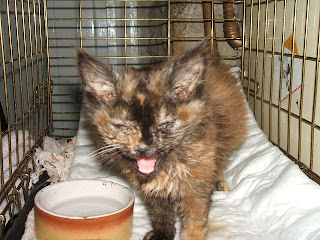 The prognosis was poor. Dehydration, diarrhoea, cat flu, skeletally thin, poor appetite not to mention the usual hangers-on - fleas and worms. Back at our centre, Marmalade was placed on a heated pad, and next to a heat source, and was fed several small liquid meals through the night. The vet was very pessimistic about her chances of survival, and frankly we couldn't have agreed more. The next few hours saw her clinging onto her life, and a second visit to the vet brought the news that she was slightly better, but still not out of the woods. Because of her constant diarrhoea, her tail and back legs were covered in faeces, but we were unable to bathe her because of the risk of her catching a chill on top of everything else. She stunk to high heaven!
That night, as her smelly dirty little body was being cuddled, wrapped in a blanket to keep her warm, we noticed a strange noise! At first we thought she was choking, but no, this feisty-spirited little lady was telling us, in her own way, that she was with us all the way in her fight for survival. A little rusty purr, probably not used for at least a few days, and interspersed by a coughing or sneezing fit every few seconds, was her gift to us and her way of letting us know she was going to grab every chance to survive this.
 Ten days on, Marmalade is still making slow but steady progress, she has been bathed and she smells better, and her appetite is improving. Most importantly her purr-song is still gorgeous.
Warning, some of the pictures in this blog may cause distress.
For a nation of cat lovers, we are sadly under-educated in many ways when it comes to the welfare of our purry friends. One thing that a lot of people don't realise is that cats can become sunburnt and this can lead to skin cancer.
The cats most commonly (but not exclusively) affected are cats who have white ears or noses, where there is little or no pigmentation on the skin.
Cats love to be out in the hot sun, dozing in the midday glare and toasting their tummies, but the suns rays can be as deadly to them as they can to humans, and like with humans, it can be easily preventable.
One way to stop your cat getting sunburnt is to keep her in during the hottest hours of the day. Let her out for a wander in the morning and then keep her in again until late afternoon/early evening when the sun's rays are less strong.
If that is impossible, you may consider using sunblock on the cat's ears. Most high factor sunblocks will be suitable, although of course the difficulty is applying it and then persuading the cat not to lick it off.
But so what, you might think. Does it really matter if the cat gets a bit of sunburn on her ears? Ask Puss-puss. She'll tell you it matters.
Puss-puss came into our care recently. Her owners moved away about a year ago and left her behind, and kind neighbours fed her. They couldn't bear the thought of her living outside in the garden for another winter and asked us to take her. Our first glance at her ears made us think that she might have sunburn. The edges of her ears were all black and scabby, and the tips were starting to fold back. We took her to the vets who confirmed our worst suspicions - yes, the ears had skin cancer, and it was spreading down towards the base of her ears. The picture above shows Puss-puss just after she came into our care - you may be able to make out a black smudge on the very edge of her right ear.
 The second two photos show sunburn in various stages - the first is an early case of sunburn, and may not develop into cancer, as long as care is taken. There are no black scabs there yet, but the ear is starting to fold a little. The second photo shows a much more advanced case - the cat here has had quite substantial scabbing on his ears and has scratched the ears so that the scab has fallen off. It will regrow.
As for Puss-puss, we had no alternative but to have her ear tips removed. Had we not done so, it is likely that the cancer would have spread. Because the scabbing was down her ears almost to her head, the amputation of her ear tips was quite extreme.
 Puss-puss had her operation yesterday, and she has been as good as gold, taking her medication, and not scratching her ears, even though they are swollen and may be quite sore. She will have to return to the vets at least a couple more times, and her hearing will be less effective. Additionally there is a chance that more dirt etc will fall into her ears.

 In Puss-puss' case, there is probably little that anyone could have done. Her previous owners abandoned her and she was left to live outside for a year or more. But if you have a cat with pale/white ears or nose, keep a bottle of high factor sunblock to hand, or better still keep him indoors during the hot part of the day.
 It might say on the bottle "not tested on animals....", but you'll know differently when you look at your cat with her pristine white ears......
What's your favourite colour? Blue, red, purple? What colour is your decor? Lime green, shocking pink, soft almond? What colour hair do you have? Silver, red, black, blond?
Of course we all have favourite colours, and of course we all look differently. And it is true that we are initially attracted to people who have a certain "look". That's normal. It is normal too, to be attracted to animals because of their appearance.
But it breaks our hearts when we have visitors to our centre who refuse to consider, or even meet our lovely black and white cats.
People seem to think that black and white cats are all the same, boring, dull, not pretty. But nothing could be further from the truth. There are lots and lots of different "regular" patterns, and as many "irregular" patterns as there are black and white cats with them.
Let's look at some of the different patterns. There's the Tuxedo pattern (or dressed for dinner), black with white paws and a white bib (and even then, they often have different patterns on their faces); there's the "felix" look - black face with a white stripe down the nose and a black body and tail with a white underbelly. That's a couple of the "regular" patterns, and even then they are not all identical.
As for the "irregulars" - the cat could be white with black blobs, white and black randomly scattered, it could have a white stripe down the nose, or a "fringe" of white; it could be black with white toes, or feet, or lower ankles, or legs - and sometimes with different colour legs - a mixture of black and white. It may have a white tail with a black end, a black tail with a white end, or even a black tail with a white ring or vice versa! It might have a "moustache" or "beard" - usually but not always black on white, or it could have a "Christmas tree" pattern, like Ben Purr, our late Cat-in-Charge who's photo appears on our blog main page. The list and the variations are endless!

 Even in a litter of five black and white kittens with a black and white mum, there are differences! Just look at these photos of Marnie and her babies to see that!
Few cat lovers can fail to be enthralled by the symmetry of a tabby cat, the sleek beauty of the oriental breeds, the fluffy perfection of the exotic breeds. But why follow the crowd? If you dismiss the black and whites you are dismissing the privilege of having something that may look unique - you would be hard-pressed to find two identical black and white cats, other than a few of the commoner patterns.
Personalities are much more important than colour. Yes, of course people will be initially attracted to a particular colour cat, but wouldn't it be nicer to have friendly personable cat who may not be the most attractive cat in your opinion, than to have a gorgeous cat who didn't suit your personality?
Here are a selection of photos of cats recently in our shelter - all black and white, and none looking like any of the others! Let's hope we get lots of comments from readers telling us how gorgeous their black and white cats are.
And don't get us started on black cats who are almost as unpopular ............ Or the people who want a cat to match their decor ............. shocking pink? Lime green? I don't think so!!!


 We often receive calls for help from people who have found cats in distress, but nothing is more upsetting than to receive calls about tiny motherless kittens. Sometimes the absence of mum-cat can't be helped - she may have been run over, or rejected the kittens, or simply be too ill to care for them. But too many of the calls we receive relate to kittens which have been dumped.
 Take the call we got just over a week ago. Some children playing in a park had found three kittens in a carrier bag. They were aged approximately 10-15 days. What chance of survival would they have had if they hadn't been found?
Hand-rearing kittens is a time-consuming and long process, fraught with difficulties and more often than not the kittens succumb to various ailments and may not survive. Even if they do survive, they miss out on essential antibodies from their mum and this can cause them to have a lower chance of surviving diseases which they may encounter as they get older.
Additionally, they don't learn socialisation skills, and although they bond well with their humans, they may become over possessive and fail to develop properly in cat society.

 When tiny, they need to be fed every couple of hours, which can be very tiring for the person feeding them, as they need to be fed through the night as well as during the day.
They also need to be helped to go to the loo. This is done by rubbing their bottoms with tissue paper or similar to encourage them to urinate and defecate.


One of the least endearing things about orphan kittens is their need to suckle. Left with mum, their instinct would be to plug in to the "milk bar" and gently suckle for a large proportion of the time, both to feed and to gain comfort. Bereft of mum, they will often suckle each other, but usually end up suckling the male kittens' genitalia. Not pleasant as this stimulates the male kitten to urinate, which then covers the kitten suckling. In addition to this, the kitten doing the suckling ingests a considerable amount of urine and sometimes faeces, which can lead to infections etc. And of course it can make the male kitten being suckled very sore.


 Back to these kittens. Two little ginger and white boys and their chintz/calico sister.
We called them Tony, Jason and Rebecca, and so far they are doing well, although they have had to have a trip to the vets because of diarrhoea. But they are doing as well as can be expected, starting to sit up a bit and take notice, and even beginning to play a bit, especially Jason. Their teeth are beginning to come through (ouch!!) and in another few days they will start to gain some bladder control. At the moment, they still have to have their bottoms wiped, and they really complain about it, especially Rebecca!
The sad sad part of all this is their poor little mum. Assuming that they were dumped because they weren't wanted, we are sure that somewhere out there, their mum is missing them dreadfully. She will be full of milk, and very uncomfortable. Additionally, she will soon come into season again and another litter of unwanted kittens will be born.
The future is bright for Jason, Rebecca and Tony, as long as they are strong enough to survive, but for their mum and her as yet unborn future litters, surely neutering her would be a more humane and caring approach.
Sadly, we'll never know!
This is a tangled tale, so take your time! We were asked by our vets in Hebden Bridge to take in Minerva (you can read about her in an earlier blog). She had been handed in as an unwanted pet to their Huddersfield branch, and transported by them to Hebden Bridge to make it easier for us to collect her.
 Meanwhile, in Bradford one of our supporters spotted a small cat on the central reservation of a busy road, which she braved rush hour traffic to rescue. Our supporter's sister (one of our volunteers) was chatting about this to someone at her keep fit class, and this person mentioned that her sister had lost a cat, near Hebden Bridge. It was quickly established (due to age and colour) that the Bradford cat wasn't the lost one in Hebden Bridge, but our volunteer remembered the one we'd taken from the vets there, and mistakenly assumed that Minerva hailed from the Hebden Bridge area.
Despite our assurances that it couldn't be their cat, the owners of the lost cat came to visit, and ruled Minerva out. But they didn't leave us their contact details to be used in the event that their cat was passed to us.
A couple of weeks or so pass. Then one of our volunteers who lives in Todmorden noticed a thin cat in the garden. She fed it and the cat moved in (into her teenage son's bedroom - brave cat!). This volunteer is also a volunteer for the local (Todmorden) Cat Protection, and also has a part time job at our vets, but at the Todmorden branch, not Hebden Bridge. She checked the CP lost and found list and the one held at the vets, but there were no matches.
Then she emailed us to ask us to check our lost and found list and to make a note of the cat's description etc. The volunteer who dealt with the email checked the l&f list and found no matches, but by chance remembered the couple from Hebden Bridge who had visited Minerva. However, there were no contact details. She remembered the original volunteer who had chatted at her keep fit class with the owner's sister, and managed to obtain her phone number.
Phoning the sister, our volunteer discovered that the missing cat actually lived in Todmorden, from where the cat had gone missing. It was looking more likely. We obtained the cat's owner's email address and dropped them a line, asking them to phone the vets to get the local CP contact number. When they phoned the vets, who should be on reception, but our volunteer who actually had the cat!
And yes, it was their cat, Pepper, who had been missing for just over a month. Our volunteer's house was in almost a straight line down the hill from where Pepper had gone missing.

A happy ending. But just think of all the coincidences
1. if our supporter hadn't found the cat in Bradford, the conversation with Pepper's owner's sister would never have taken place.
2. if we had collected Minerva from any other branch of the vets, there would have been no connection with Hebden Bridge and Pepper's owners would have had no reason to contact us.
3. the volunteer who dealt with the email remembered Pepper's owners visiting Minerva (it could have been one of several volunteers who dealt with the email).
4. Pepper had the sense to turn up not only at the home of a CP volunteer, but at the home of the one volunteer who helps us as well.
We are so pleased that Pepper's owners have been traced. We understand that her owners are going to get her micro-chipped, which in future may remove the need for coincidences.
It's funny how we seem to get "phases" of types of cats. The current phase seems to be feral mother cats with kittens who can be tamed up.
 The first lot were Jessica & Millicent and their eight babies - although there were such a mixture of ages that we wondered if there were more than two mother cats involved! Jessica & Millicent were living in a factory and had to be caught using a trap. Luckily, the kittens weren't too bad and we were able to tame them up. The youngest three, George, Dennis and Fred are due to go to new homes this weekend, and we hope to find an outdoors home for Jessica & Millicent before too long. They will provide a great deterent for invading rodents!
 Next we took in Tootsie - she was living in someone's garden, and when they realised that she was pregnant, they asked us to help. Again, she had to be trapped. A couple of weeks after she came to our centre she gave birth to four kittens, now three and a half weeks old.

 Finally, we were told about Marnie, again a pregnant stray living in someone's garden. We sent a trap out but she had the kittens before we could catch her. Luckily we were able to trap her the next day and bring her and her five kittens to safety. The kittens are about 5 days old now.
In many ways catching the cats is the easy part. The difficulties start once they are with us. Of course the kittens need to stay with their mums for some time so that they can benefit from her milk and so that they can be cleaned and groomed and begin to learn catty-manners. But they also need to learn to trust humans and to be comfortable being stroked and picked up. With a tame cat it is easy to pick out the kittens to handle them, however, it is a different matter with the kittens of feral cats. The kittens need to be checked daily, to ensure that there is no infection in their eyes, and as they get older they need to be played with and cuddled to get them used to being handled by humans.
Easy peasy you might think! Just distract mum, grab them and then check them and play with them for a few minutes before returning them. Unfortunately it is not as easy as that! The mother cats don't realise what is happening the first few times but gradually as they begin to understand that their babies will be removed (they conveniently forget that they will come back later!) they become more aggressive and will spit, swipe and even stand over the kittens to hide them. This calls for gauntlets, thick clothes and a certain degree of nerve.
Even that isn't too bad until the kittens start to wander around their pen. Once they get to that stage our volunteer not only has to cope with a seriously irritated mum-cat, but has to dodge around the pen to try and catch the kittens and manage not to stand on the ones not yet caught!
We normally keep kittens with their mums until they are ten weeks old, putting them in a foster home for the duration of their stay with us so that they become used to living in a home and being handled. Then we have them neutered prior to finding new homes. With feral kittens we tend to separate them at about eight weeks and put them in a foster home for a month to get them used to living in a house with people, as of course we can't put them in a foster home earlier due to the feral nature of their mums.
As to the mum-cats, they are neutered and if possible returned to the site from where they came (Marnie will be going back to the garden where she came from, as the finders have agreed to feed her and provide shelter for her). Those we cannot return remain with us until we have found outdoor homes for them - in stables, farms, allotments or even safe factories or commerical units.
If you become aware of a feral cat living in your garden, please act responsibly like the finders of Tootsie and Marnie, and alert your local rescue. If you can have the cat back once it has been neutered, that would be great, and of course if you act responsibly the stray population in your garden will remain at one, whereas if you ignore the cat, you may soon find you are having to ignore far far more than one!


Isn't it funny how two cats, of similar age and from similar backgrounds can have such different personalities? Take Nillie (short for Vanilla), the white cat pictured. She had lived with a single person who sadly died, and because no one in the family could take her, she came into our care. She is desperately nervous of most people and not only does she hide, but she spits as well. She is completely traumatised by most things and if given the chance will hide all day under her blanket.
She has so far bonded with one of our younger volunteers, who is just about the only person who can approach her. (Suggestions to our volunteer that she put herself up for adoption with Nillie fell on deaf ears!) But it is a start. Nillie will probably be with us for a long time, whilst we gently work through her fears and show her that there is nothing to be afraid of. Once we do rehome her, she is likely to revert and become nervous and possibly aggressive for some time, so we need to find a new owner who will be prepared to give Nillie the time to settle and develop.

Then on the other hand, we have Frisky, the ginger lad pictured. Like Nillie, his owner recently died, and no one in the family could take him. He is roughly the same age (he's three, Nillie is 2½), and yet he is completely laid back, likes to lie on his back in your arms, waving his paws and purring, and he is intensely curious about all that is going on around him. We anticipate that we will be able to rehome Frisky as soon as he has been neutered (he's booked in for tomorrow).
Some of it is down to personality of course, but a lot of cat behaviour can be traced to how they are treated as kittens and/or young cats. A cat who is handled and stroked often will become confident around people. S/he will learn to trust and will cope with changes etc - although of course there may be a little bit of uncertainty at first. A cat who isn't handled much, who is allowed to hide and doesn't become used to strokes and fussing will be more nervous and will find any change to be a complete trauma.
If you have a young cat, please handle him or her as much as possible, so that if there have to be any changes - even a holiday stay at a cattery - it will be less traumatic for all concerned.
A quick update on some of the cats featured recently. We have found homes for both Minerva and Sabrina, and the cat-flu kittens, Graham & Sylvia are much much better. Thank you to all those who enquired.
 Take Marmalade, for example. She was found laying in a gutter, close to death - badly dehydrated and with the beginnings of cat flu. Not far away, an adult cat with similar colouring, was found dead, believed run over. We think this was her mum. Marmalade was brought into our small shelter, a tiny wretch who voraciously ate a spoonful of food and then settled down for a weary sleep. The stream of foul smelling diarrhoea trickling unnoticed from her prompted us to get her to the vets as quickly as we could.
 The prognosis was poor. Dehydration, diarrhoea, cat flu, skeletally thin, poor appetite not to mention the usual hangers-on - fleas and worms. Back at our centre, Marmalade was placed on a heated pad, and next to a heat source, and was fed several small liquid meals through the night. The vet was very pessimistic about her chances of survival, and frankly we couldn't have agreed more. The next few hours saw her clinging onto her life, and a second visit to the vet brought the news that she was slightly better, but still not out of the woods. Because of her constant diarrhoea, her tail and back legs were covered in faeces, but we were unable to bathe her because of the risk of her catching a chill on top of everything else. She stunk to high heaven!
 Ten days on, Marmalade is still making slow but steady progress, she has been bathed and she smells better, and her appetite is improving. Most importantly her purr-song is still gorgeous.


